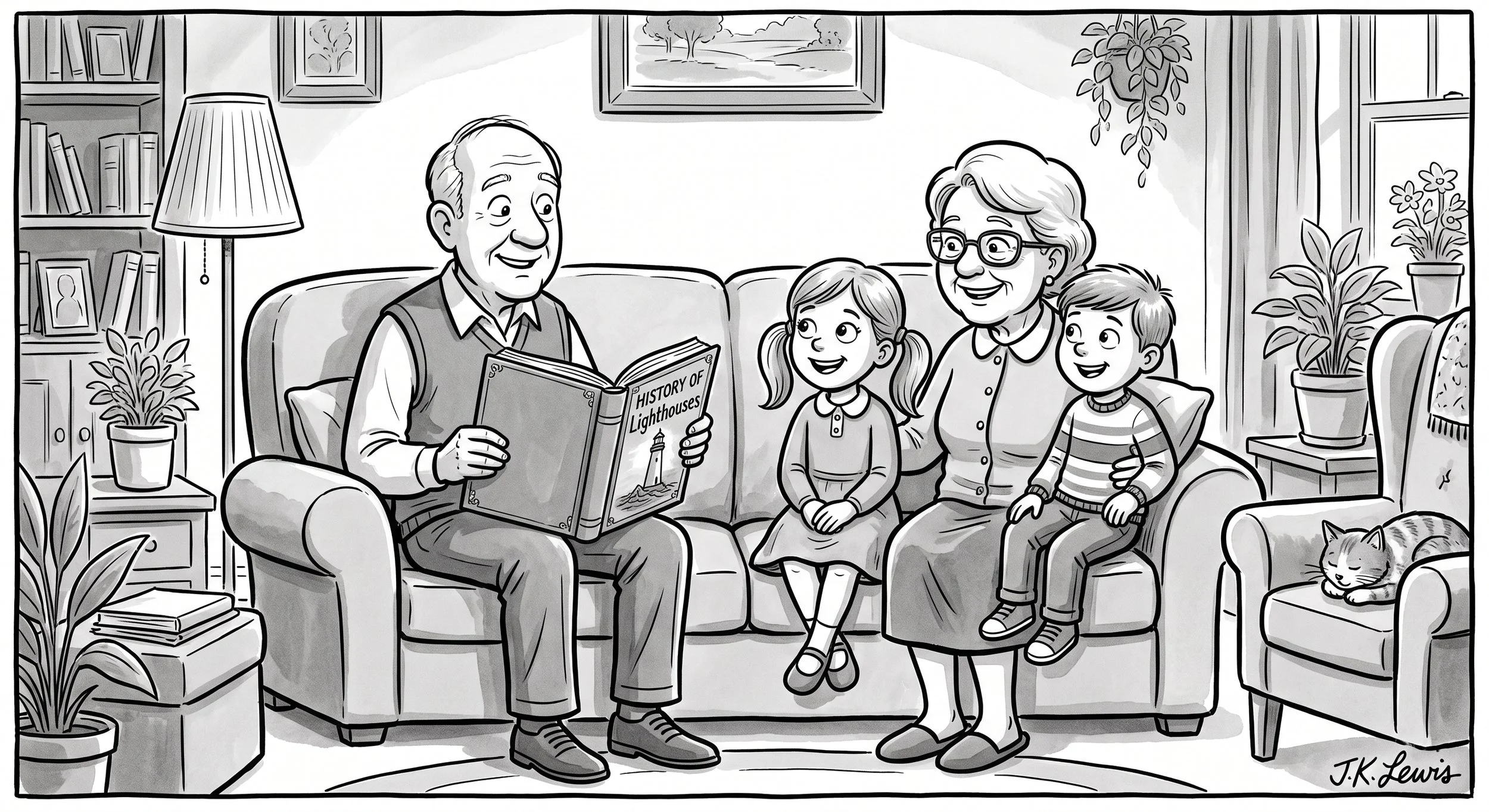
Look past the inherent tension with a goal of figuring it out
Grandma, Nonna, Mimi, Meemaw, Oma. The word alone has emotional connections for most people. Multi-generational survey results like the September 2023 YouGov poll suggest that over 70 percent of people have either strong positive emotions toward a grandmother or positive memories of the impact grandmother(s) had on their life. In general, grandmothering is good.
Yet 43% of moms and grandmas are fighting tension. Why do some parents pull away from grandparents? How are some grandmas feeling displaced, obsolete, or discarded after decades of looking forward to this stage of their lives?
Reddit readers post dozens of pointed questions: “What’s wrong with this generation of Grandparents?”, “Clashing with poorly parented grandchildren”, “I’m sick of being Daycare for my grandson”, “How do you have a relationship with grandchildren when their parents won’t talk to you?”, “Why are Grandparents so difficult to deal with?”
What explains the gap between the deep positive associations most people feel and the friction that appears in real families? To unravel this, we first have to look to some evolutionary biology and basic economic logic.
Grandmothers are predisposed to support their grandchildren.
One of the interesting facts about humans is that we are only one of a tiny number of mammal species whose females live considerably past their childbearing years (humans, a few toothed whales, and potentially some chimpanzees). This phenomenon, which researchers call ‘the grandmother effect’, allows females to provide valuable support to a kin group without reproductive pressure.
All animals have a self-preservation instinct. They not only work to survive and thrive personally, but they also seek to extend their genetic material to offspring.
W. D. Hamilton in the 1960s solved a problem that Charles Darwin thought was a flaw in his theory of evolution. Why would a sterile worker bee give energy to help the hive? How could evolution explain altruism in humans? On the surface, the Grandmother gains nothing from the relationship. Natural selection should have weeded it out.
Hamilton recognized that the optimizing animal has an incentive not just to survive, but to pass on their genes. A grandparent, therefore, benefits by helping to successfully raise a grandchild. Their genes profit, even if they don’t have extra offspring themselves.
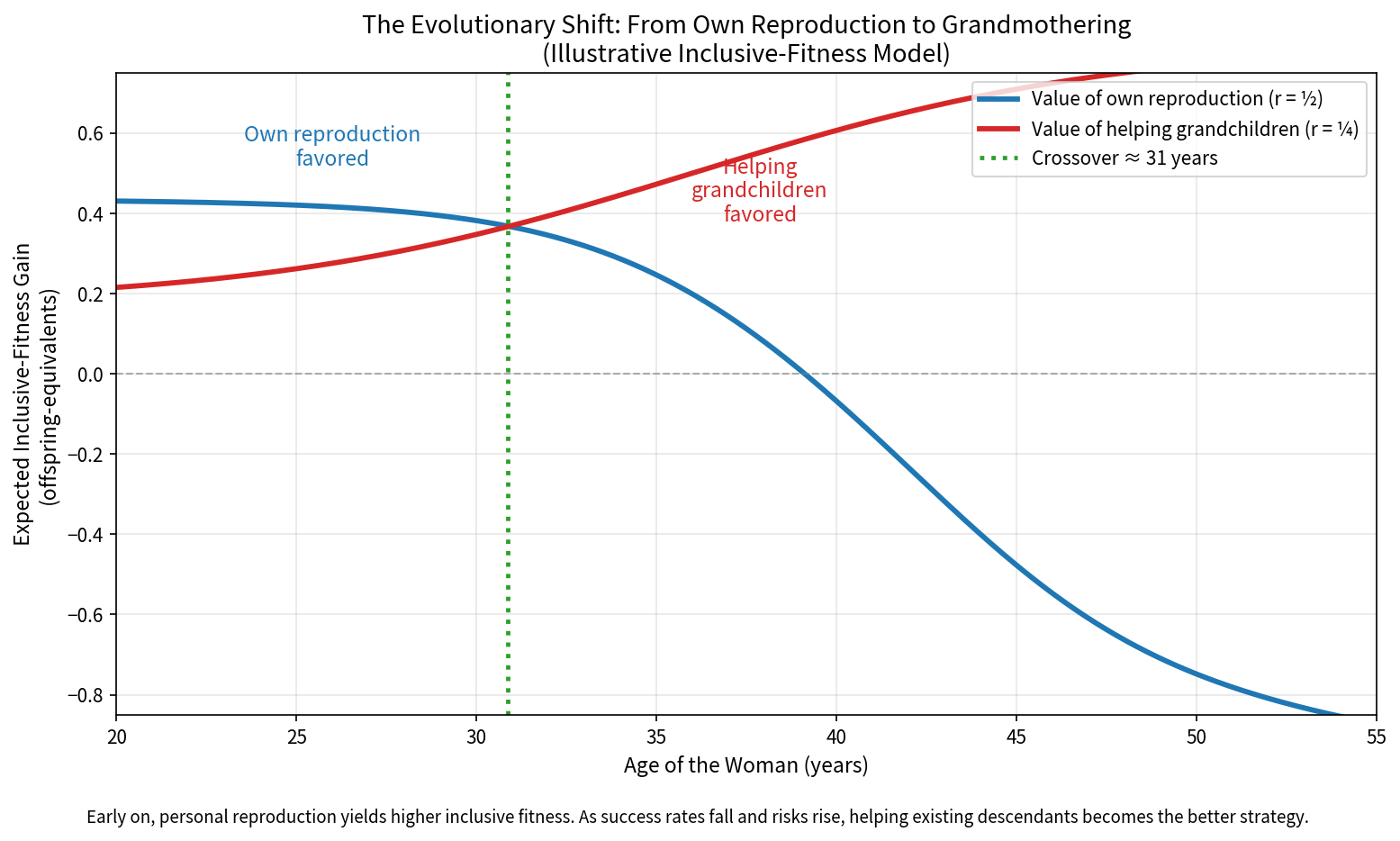
The chart is different for every mother-child pair. This version reflects historical human norms
A child carries half of a parent’s “relatedness.” The fierce protection of parents for children stems from this instinct.
The child also carries one-quarter of grandparent relatedness. By the time most women are in the position of being a grandmother, the capability for additional children of their own may have faded. The risk of death for mothers in childbirth also rises with age. There is a crossover point where the benefit of passing on their genes favors grandparenting over direct parenting. The help also allows mothers to have additional children faster, further passing genes forward.
The forces that drove ancient grandmothers to help mothers forage for food are still with us. James Rilling at Emory University used MRI to scan grandmothers as they viewed photographs of grown children, grandchildren, an unrelated child, and an adult stranger. While their children's photos triggered cognitive emotions, the strongest empathetic emotions were triggered in grandchildren most often.
Why Grandmother? Why not Grandfather? Grandfathers have a similar attraction to extend their gene pool. But the grandfather is complicated by additional factors: for example, they can continue to reproduce long after a woman of similar age, although at far lower probabilities than a younger man. Many of the same signals are there, and much of this piece can work for Grandpa, but often the grandmother is the better control subject for these analyses, and far more often provides care and support.
Is there a difference between daughters or daughters-in-law? Not in a pure situation where paternity is certain. Both the child of a daughter and the child of a son are equally related. However, in societies where it is possible for the child not to be the offspring of a son (in some social conditions, the average doubt can be 1-2%), the lower probabilistic relatedness slightly favors the maternal grandmother.
Without the lifelong history of mother-daughter relationship, which has absorbed years of conflict, daughters-in-law are at a communications disadvantage. Sons can play a positive role in helping both parties reduce friction.
In some cultures, like Southern European and the Jewish diaspora, the maternal line traditionally is central to domestic life through multiple generations. Practices and expectations may be in conflict with cultures (like Anglo-Saxons) where adult independence is favored.
Modern life raised the stakes
As recently as your parents’ generation, large families with close grandparent support were the expectation. Over the past few generations, several factors have impacted grandparenting.
Smaller families
Increased opportunity cost of childbirth
Physical distance
Later childbirth
Longer nest time
Lower child mortality rates have allowed modern families to concentrate more investment into fewer children. This raises the stakes for both the mother to get it right and for the grandmother to want to be more involved than they would be if they had more.
Women in modern society have a significant earnings sacrifice to have children even if they remain in the workforce. Grandparents can reduce the negative impact through free childcare. This comes at a cost to the parent, ceding some control in exchange for a big commitment by the grandparent. However, if these demands are aligned, all three parties can benefit.
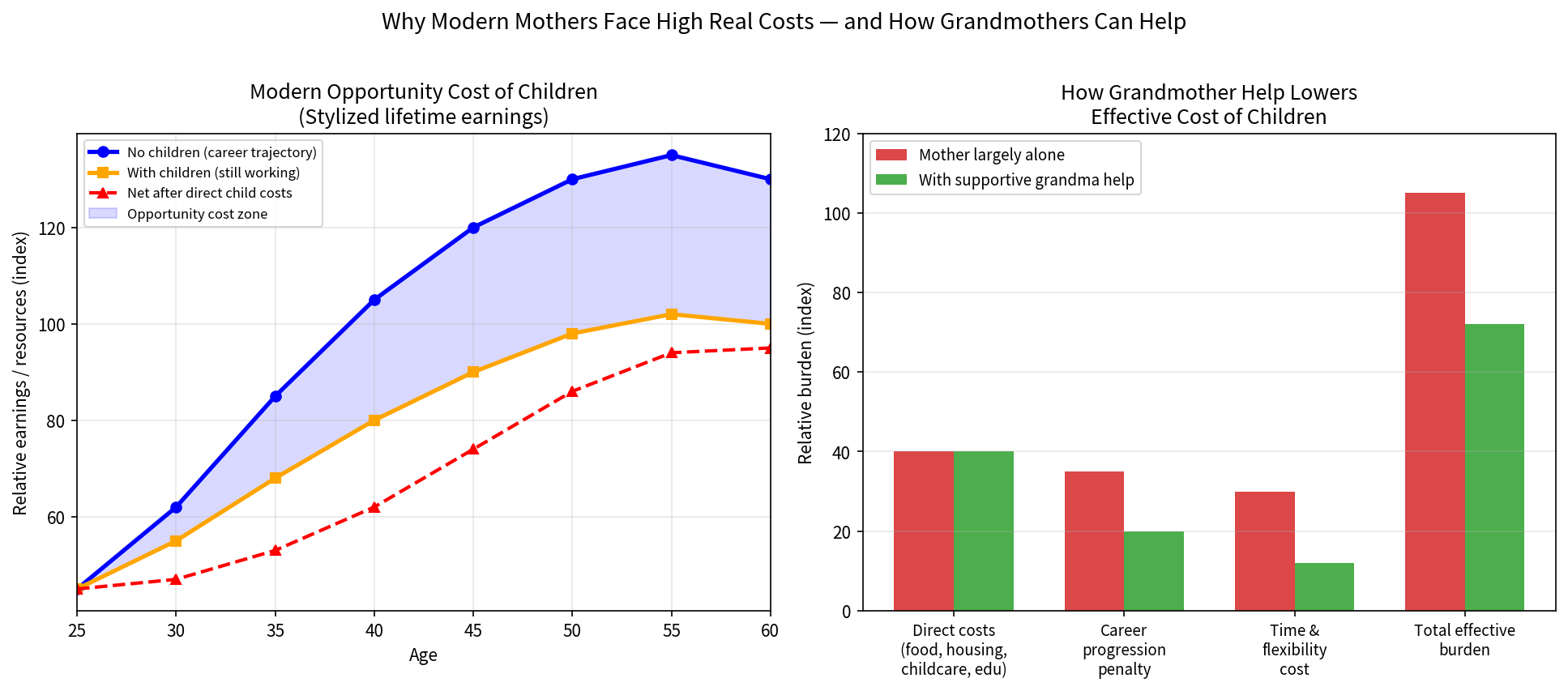
Grandparents can offset the negative career costs of having children (Author)
In the past, travel was significantly more expensive, and family groups tended to stay together to pool resources and help. As offspring have physical separation from parents, opportunities to grandparent or to draw on them for help are significantly reduced.
Several factors have pushed average first births out almost to age 28, up from 21 in 1970.
Widely available birth control
Increased value placed on education and career for women
National Bureau of Economic Research (NBER) studies on dating app penetration—find a statistically significant negative association between intense dating app adoption and rates of new marriages.
The impact of later births is smaller families and higher stakes in the fewer births.
Education, student debt, housing costs, and later entry into the workforce have raised the average age of independent living to 27, increasing the total investment in offspring.
When mothers are older, grandmothers are almost certain to be near the end of their fertility. In earlier times, a first-time grandmother may still have had children of their own at home.
So we know grandmothers still carry a strong evolutionary bias to contribute to the well-being of their grandchildren. Is the relationship still beneficial?
The studies support Grandma:
Research across developmental psychology, sociology, and gerontology consistently shows that a close, caring relationship between grandparents and grandchildren yields measurable emotional, cognitive, and physical benefits for both generations.
Reduced Emotional and Behavioral Problems in Children
University of Oxford Study (2008): Led by Professor Ann Buchanan, a study of more than 1,500 children aged 11 to 16 found that high levels of grandparent involvement were linked to significantly fewer emotional and behavioral problems. Grandparent presence acted as a major buffer against the distress caused by adverse life events, particularly family breakdown, parental separation, or bullying.
Lower Rates of Depression in Both Generations
Boston College Longitudinal Study (Moorman & Stokes, 2014): Published in The Gerontologist, concluded that strong emotional closeness between grandparents and adult grandchildren directly reduced symptoms of depression in both groups.
Increased Prosocial Behavior and Social Competence
Brigham Young University Study (Yorgason et al., 2011): Published in the Journal of Research on Adolescence. The researchers found that close grandparent-grandchild ties were directly linked to higher levels of positive social behaviors (such as empathy, kindness, and cooperative play) and improved academic engagement.
Cognitive Protection and Mental Sharpness for Grandparents
The Women’s Healthy Aging Project (Burn & Szoeke, 2014): postmenopausal grandmothers who spent one day a week caring for grandchildren scored significantly higher on working memory and executive functioning tests compared to those who did not. Excessive caregiving of five or more days per week showed diminishing cognitive returns, indicating that moderate, supportive involvement is best.
Psychology and Aging Study (Flavia Cherecheș, 2026): Longitudinal data tracking nearly 2,900 grandparents found that those actively assisting with child-rearing tasks (helping with homework, playing, babysitting) maintained stronger memory and verbal fluency scores over time compared to non-caregiving peers.
Longevity
Berlin Aging Study (Hilbrand et al., 2017): Grandparents over 70 who provided regular, non-custodial care to their grandchildren had a 37% lower mortality risk over 10 years than non-caregiving grandparents, driven by increased physical activity, lowered social isolation, and enhanced sense of purpose.
Grandparenting can have some negative effects; most notably, children generally fare worse when the grandparent is the de facto parent or when there is significant conflict over control and discipline.
So if grandparenting is natural and good, why is there tension?
Higher stakes produce higher friction.
Why the Clash Intensifies in Modern Conditions
Reduced need for survival help: Child mortality is extremely low. The large fitness benefit that once made grandmothering so valuable has shrunk. Mothers therefore experience grandmother involvement less as essential support and more as optional (or even optional-but-intrusive).
Different cost structures: The modern mother often faces high opportunity costs (career, education, personal autonomy, preferred parenting philosophy). Grandma’s involvement may frustrate or constrain mom’s choices. Alternatively, parents may need the income or to preserve their careers or homes, and rely on the grandmother(s) for help. This level of help may exceed the grandmother’s perceived benefit.
Evolved psychology lags behind the new environment: Grandmothers retain strong evolved motivations to nurture, advise, provision, and sometimes “spoil.” With modern healthcare, babies are rarely in ‘danger’. The result can be persistent offers of help, advice, or material goods that the mother experiences as intrusive or undermining of her authority.
Asymmetric information: Grandmothers may favor different child-rearing styles; some outmoded. Mothers may prioritize recent trends, specific educational or emotional approaches, or simply independence. They may not value grandmother’s experience as much as grandmother values her own years of motherhood.
Because grandmother often approaches from a position of seeking joy along with her experience of childhood resilience, using statements like, “They will be fine”, often conflicts with mom, who bears the bulk of the responsibility for the outcomes.
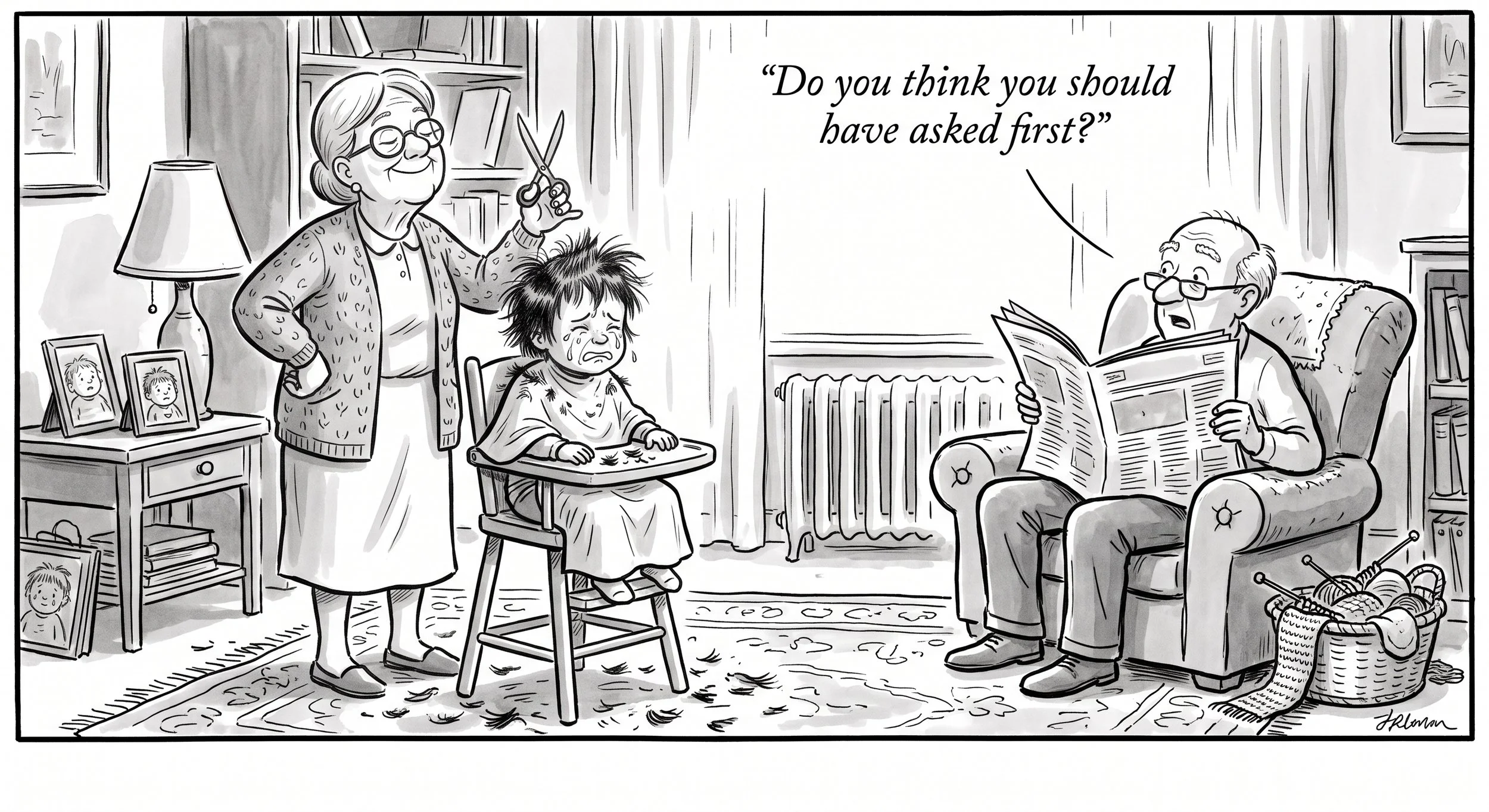
Generated by Gemini with prompted scene from the author
Ancestrally, a new mother was supported by an intimate, local village of experienced kin. Today, that physical village has been largely supplanted by an algorithmic datastream that monetizes her anxiety, isolates her from her elders, and demands perfection.
Why Today’s Mom is under more pressure than Grandma may understand.
Body image: Today’s moms have grown up with front-facing camera phones for most of their adulthood. They live in a judgment zone and have been the subject of hundreds, if not thousands, of online images. The physical and hormonal changes leading to childbirth rapidly change the body in ways that do not align with the curated online image of themselves. The pregnancy, the body recovery, and the shift to motherhood are the subject of scrutiny and judgement from curious friends and acquaintances, and others who follow them.
The Commercial Algorithms and Mom’s Education
Two things happen when the algorithms detect a woman is pregnant. First, she spends more time on social media. Studies almost universally show expectant mothers increasing the frequency and total time online. Almost 90% of American women have access to social media, where they routinely seek information. This always-available stream feeds their need to understand what is happening to their bodies and to their baby. They are also looking for new peer support and comparisons. Pregnant women have more time with altered sleep patterns and are generally more sedentary than when not pregnant. First-time moms especially increase online time. Time spent scrolling ranges between 3 and 5.5 hours per day, far outpacing discussions with their parents or in-laws. (Yang 2024 Biomed Central)
Second, she becomes more valuable to advertisers. Having a child is an event that triggers unique spending habit changes. This encourages more influencers to enter the space, and they create deeper content to capture this audience. Advertisers are willing to spend 50% more to address prospective moms. New mothers represent what marketers consider the "holy grail" consumer event: an abrupt, total disruption of established brand habits coupled with a massive expansion in purchasing authority. They become less price-sensitive and will be spending an average of $15,000-$18,000 as they prepare for a baby (Brookings Institution & BabyCenter). Mom will control up to 85% of the future purchasing decisions for her family. (The Female Economy by Silverstein & Sayre)
Walk for a moment in Mom’s shoes: She is flooded with information, some good, some troubling. But she is educated. Mothers are natural learners and problem solvers. The messages are powerful:
Pregnancy detection: When Facebook, Instagram, and TikTok detect that a woman is visibly pregnant, influencers, models, and ad campaigns drive popular themes:
Almost all expectant moms are attracted to content that supports their desire to do well and look good doing motherhood. Algorithms heavily favor visually curated, aspirational pregnancy imagery. Visibly pregnant models and lifestyle influencers are pushed into feeds demonstrating "bump-only" weight gain, smart styling, intensive prenatal fitness routines, and stretch-mark-free skin. The message is that physical desirability and body control must be maintained throughout pregnancy, quickly followed by content promoting rapid postpartum “Bounce Back” recovery and pressure moms to erase the physical evidence of childbirth as quickly as possible.
Another category peddled is Fear. The shocks of birth trauma and worst-case scenarios arouse and keep Mom’s eyeballs. They also push a moralized version of consumerism. Influencers imply, “You need this product. It is your duty as a good parent.” They also promote “Clean living”: Supplements, seed-oil-free diets, organic-only baby wardrobes, and fear-based avoidance of common household items labeled as "toxic."
Neutral-toned, hyper-organized nursery setups modeled by influencers frame consumer purchases as prerequisites for competent parenting. When it is close to birth, the narrative shifts to idealized birthing situations, home births, or model hospital settings: no annoying visitors, mom and dad alone with baby, mother’s hair and makeup somehow intact.
After Birth: Once social platforms identify a first-time mother, the algorithm shifts from prenatal anxiety to high-stakes infant care. Driven by retention metrics that prey on sleep deprivation, inexperience, and vulnerability, feeds converge on dominant narratives:
Recommendation engines exploit the intense protective instinct of a novice parent with safety advice. The algorithm serves an unending stream of preventable dangers. Routine infant behaviors could be covert medical crises. Moms need to be vigilant, urgent, and perfect to avoid irreversible harm, driving high comment engagement as worried mothers seek reassurance.
Algorithms heavily promote infant sleep coaches, feeding consultants, lactation and weaning advisors, and pediatric development "gurus". The prevailing message is that infant unpredictability is a failure of technique rather than normal biology.
Mom’s screen shows influencers with an ultra-curated, serene maternal life that is completely detached from the chaotic reality of postpartum recovery and infancy. Exclusively wooden toys, anti-plastic and organic, are equated to better parenting. This feeds a push to a high-end registry. You NEED the $1,000 stroller, or a luxury car seat, or a diapering ‘system’ as functional necessities.
Surely, moms are bombarded with information, and the anxiety and vulnerability that comes with it. We should not go as far as to conclude social media is harming them.
Mothers are not fragile victims of their screens. A 2024 analysis in JAMA Pediatrics of 143 studies featuring data from over one million adolescents worldwide, many of whom are now at child-rearing age, found that links between social media use and poor mental health among youth were small, inconsistent across studies, and nonclinical samples. We can agree that social media drives commercial engagement and information at a cost.
Moms come to the parent-grandparent relationship older, with mountains of information, strong pressures and convictions, facing judgement from a wide audience. They have the largest investment in their children. They bear the consequences of their actions. Older adults often underestimate the capabilities of younger adults.
Always on
The information flow includes a steady reminder of ways parents are falling behind as they see peers’ curated lives. Modern parents have to live with their children being on display from birth. There is pressure to effectively schedule an entire childhood experience, document it, send and post, juggle activities, plan pre-schools, camps, play, and athletics. There is pressure to be present for everything without neglecting children’s diet, sleep, exercise, mental health, and social development, while also keeping up with the wash and the bus driver’s email. This often leaves little room for the attention and nuance grandparents expect.
Observable Patterns
Higher rates of reported tension around issues such as feeding, sleep training, discipline, screen time, and spoiling.
Mothers sometimes limit contact or set strict boundaries precisely because the grandmother’s motivation to invest remains high while the mother’s perceived need for help and information has fallen.
In some cases, the conflict is mild or absent (especially when the grandmother provides clear instrumental help that aligns with the mother’s goals). In others, it becomes a significant source of family stress.
Other grandparents may feel like vetted subcontractors, or that their decades of experience have been overruled by an influencer who has been a mom for two years.
Predictable Frustrations — and What the Data Show
Surveys and studies consistently find that differing expectations around childrearing are common.
A C.S. Mott Children’s Hospital poll found that 43% of parents reported disagreements with grandparents about what is best for the grandchildren, most often over discipline, food, screen time, and routines. When grandparents were told about the conflict but did not change their behavior, a substantial share of parents responded by limiting time with the grandchildren.
Communication gaps amplify the problem. Research on parent–grandparent coparenting repeatedly identifies unspoken assumptions and poor-quality communication as major drivers of conflict.
Many grandparents who experience reduced or lost contact describe themselves as confused or having “no idea” why the relationship changed. Accounts of estranged or restricted grandparents frequently note bewilderment and a sense of sudden erasure.
Parents, by contrast, often report that they did express boundaries or concerns—yet felt unheard, or that the pattern continued despite conversations. The two accounts can sit side-by-side in the same family: one side believes explanations were given; the other experiences the restriction as abrupt and unexplained. Unspoken or incompletely heard assumptions about roles, advice, time, and decision rights create much of this friction.
Grandmothers can also be pulled into heavy, ongoing provision of time or money that exceeds what is sustainable for them. Because their primary remaining inclusive-fitness pathway runs through the grandchildren, restricted access feels especially consequential. Mothers, carrying high real costs and raising fewer children, may feel intense responsibility to control inputs and outcomes. Both sides can end up feeling unappreciated.
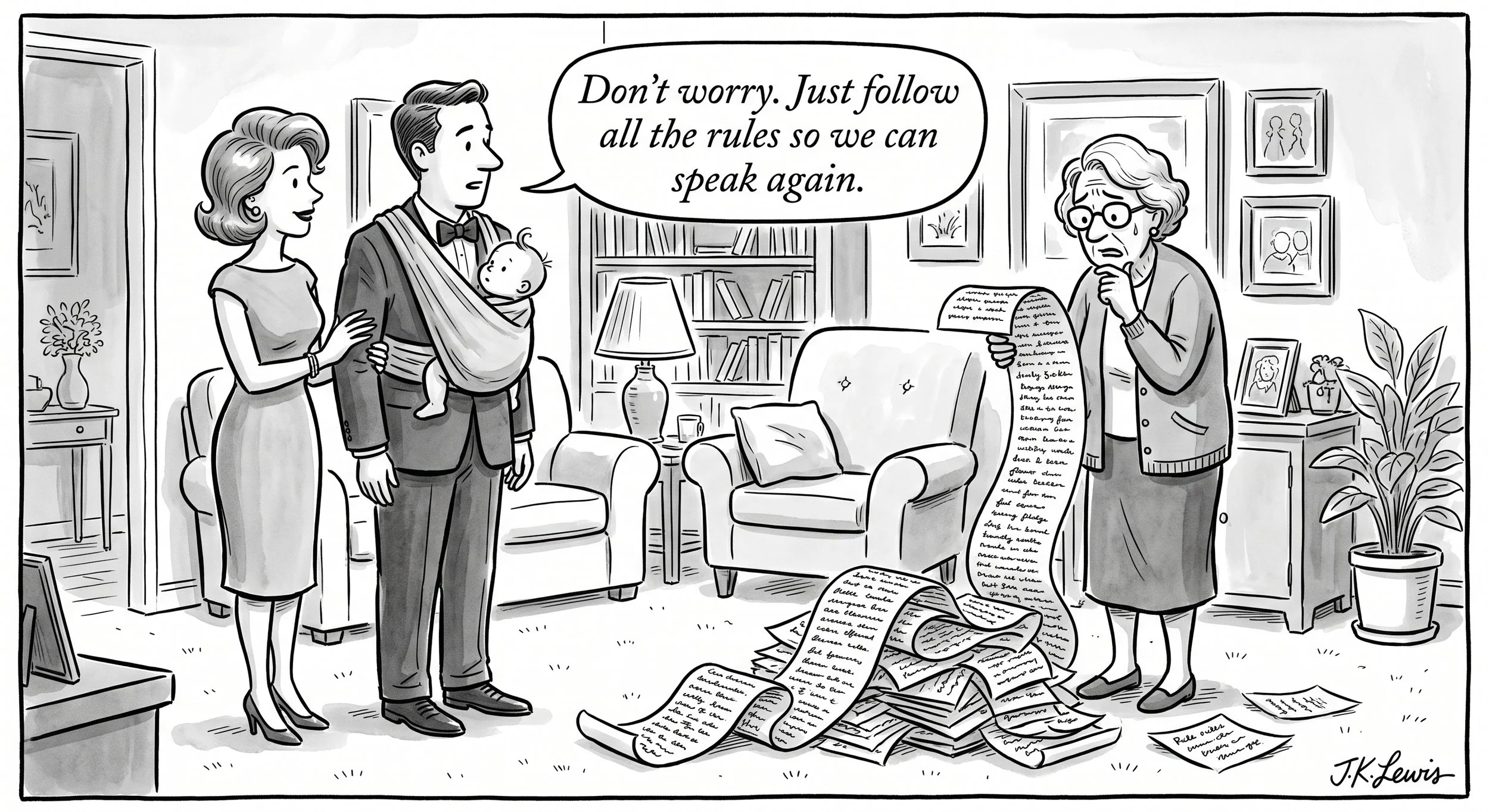
Generated by Gemini with prompted scene from the author
Practical, Actionable Advice
For grandmothers
Treat your help as a gift offered on the mother’s terms, not as an entitlement or a chance to direct. Have humility about your own knowledge.
Grandma: “I know this has changed since you were a baby. What does your pediatrician tell you about putting baby to bed?”
Grandma: “What would actually make life easier for you this month?”
Hold back advice unless asked. Commentary that implies a better way often activates the mother’s protective response. But be available.
Grandma: ”You are navigating a firehose of information that didn't exist when I was a new mom. Do you want my perspective on this, or do you just need me to listen?”
Be honest with yourself about your own limits of time, money, and energy. Over-giving past the point of true benefit to you helps no one long-term.
Notice that becoming a grandmother later in life concentrates your investment window. Spend your years on relationship quality more than on volume of advice.
If contact decreases, resist assuming the worst in silence. A calm request for clarity.
Grandma: “I want to understand what would make this easier”
This approach is more effective than withdrawal or protest.
Grandma: “I love you and your baby too much to let unspoken friction build between us. What is one thing I’m doing that feels like friction? What is one thing I can do now that would actually feel like relief?"
Resist the urge to beg for time with the grandkids.
Many times the tension is released as the chaos of real life settles in, and you can be helpful. Second and third children also make grandmother help more valuable. Be evenhanded with love. Little hurts a mother more than seeing one of their children treated unfairly.
Learn to laugh at yourself. While you may be able to provide wisdom and experience, you are at times going to appear hopelessly old-fashioned as you age. It’s ok. Your children and even more likely your grandchildren will love you for it.
For mothers
Recognize that the grandmother’s pull toward your child is an ancient, relatedness-driven motivation, not primarily a desire to interfere. Motherhood is a special achievement. Most have a need for emotional empathy from other mothers, which grandmothers can readily provide.
Default toward inclusion. Practical help that reduces your real costs (childcare, meals, errands, flexible backup, guidance) is one of the few things that can lighten the modern burden.
Set clear, kind boundaries on methods and decision-making authority, then let the relationship breathe inside those boundaries. State your direction out loud, more than once if needed. Assumptions will fill any gaps. Ask yourself if you are being overly rigid. Ask yourself how you would react to this. You may be gifted with being a grandmother one day.
Mom: “You did a wonderful job with your son. I’m sure you used the best information available when he was young. There are new approaches to feeding schedules, and here’s why nutritionists believe they are better.”
Remember that your child has fewer automatic adult relationships than children in larger historical families. Respectful grandmothers are a meaningful addition, and almost always leave a positive impression on children. Grant them some latitude to spoil a little in a way acceptable to you.
If you need to limit involvement, explain the practical reason rather than leaving the grandparent to guess. Clarity reduces the “I have no idea why” experience that many restricted grandparents report.
Mom: “I’m taking a step back from visits for the next two weeks. It's not a punishment or a permanent cutoff—I am physically exhausted and overstimulated, and we need time to establish a basic routine without entertaining guests.”
Mom: “Your son and I agree that no images of baby should be posted to the internet. We have few non-negotiable rules, but we must be firm with this.”
Your lives evolve. Infancy is a short window. The benefits of grandparent involvement rise as babies grow. Figure out meaningful ways to let others love your baby.
Laugh often. Some of the best online sarcasm is moms and grandmas in the extreme. See yourself and Grandmas in the comedy. Laughter salves many frustrations.
For both
Talk early about expectations around time, money, advice, and decision rights. Data and clinical experience both point to unspoken assumptions as a primary source of escalating friction.
Focus on the shared interest: a child who feels securely attached to more than one generation tends to do better emotionally and socially.
Recognize that algorithms are designed to manipulate both of you. Stand back and challenge your own convictions. Am I unnecessarily afraid or stubborn about my views?
Accept that perfect alignment is rare. Note that permanent relationship breakdown is rare. Good-enough cooperation is a realistic and valuable goal.
The biology that made grandmothering advantageous is still with us. The social and economic conditions surrounding it have changed faster than our instincts. When both generations see the relatedness math, the historical shift, the modern cost pressures, and the common communication gaps clearly, they are better equipped to adjust: protecting the mother’s authority and bandwidth, allowing the grandmothers the right balance of involvement, and giving the child the benefit of both.
On balance, grandparenting is valuable, and managing it well is part of good parenting. Lean into it.
-Vincent Dicks celebrates the benefits of grandparenting as a part of healthy aging in The Rule of 70: A Single Rule for a Rewarding Life.