Available in E-Book, Audiobook, Hardcover
For America 250, I have completed a new book. Sea Girt Soul Commodore Robert Field Stockton tells the story of the man who named our fine town. A sample chapter is provided below.
The e-book, audiobook, and hardcover are all available as of today! Buy on Amazon
Please pass on the news. Word of mouth works best!
Grandson of a Signer. Conqueror of California. The Architect of a Divided Empire.
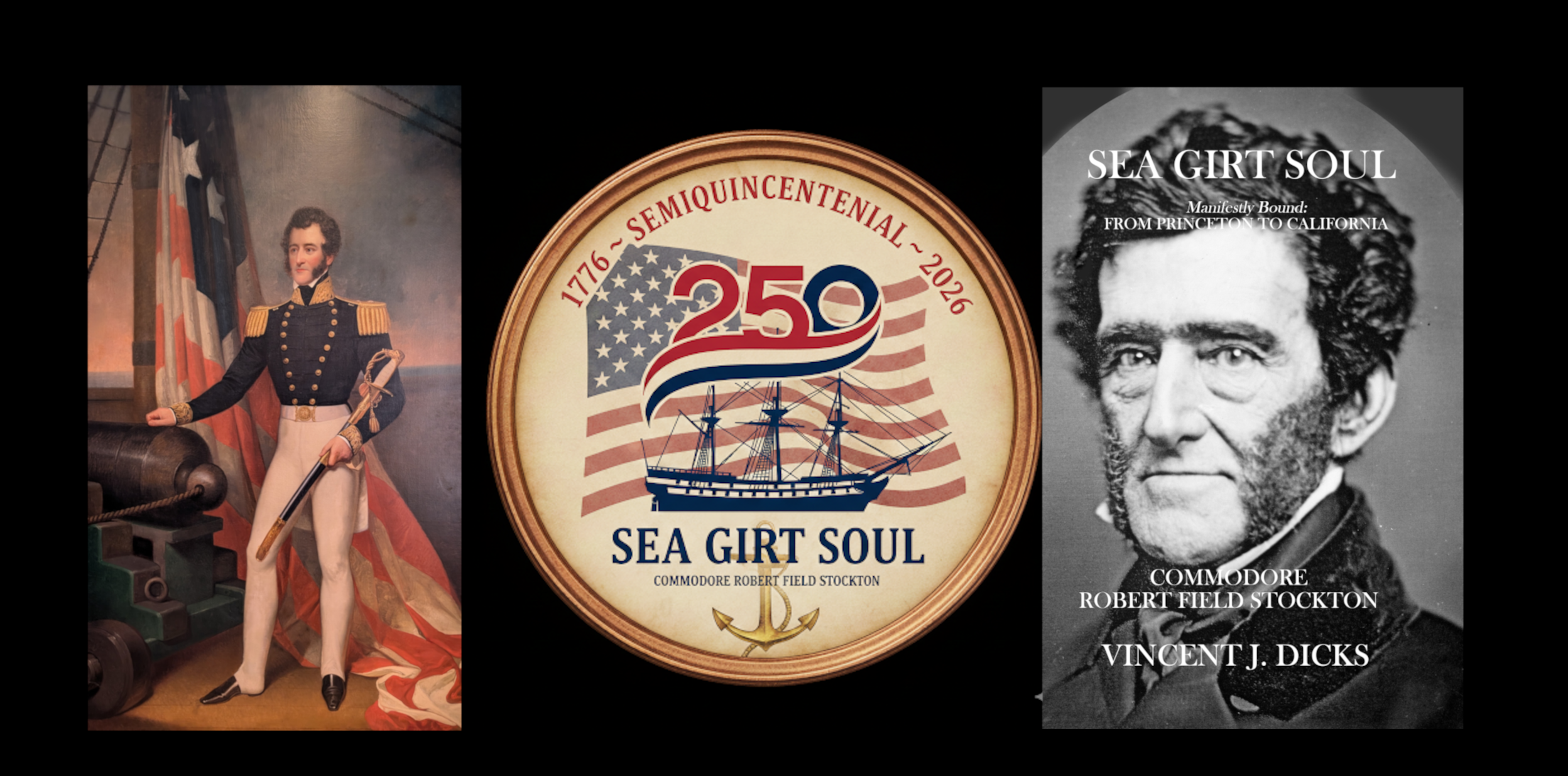
Robert Field Stockton was born to American aristocracy.. His Grandfather signed the Declaration of Independence, His father was a Senator, and Head of the NJ Bar. With high expectations and the zeal of a second son, he entered the young US Navy. in 1811
His settings were dramatic: the War of 1812, the Second Barbary War, Slavers off Africa, sea battles with Caribbean Pirates. He convinced Texas to join the US. Conducted diplomacy in the island nation of Hawaii, and he conquered the California coast for a growing Union.
His canal enterprise and political clout made him a formidable opponent in business or politics. He oversaw the development of the first screw propeller battleship for the US Navy, which covered him simultaneously in brilliance and tragedy.
Sea Girt Soul follows the meteoric rise of a Commodore who stood at the pinnacle of power—with a Senate seat, a sprawling Jersey Shore estate, and whispers of the Presidency—all while remaining tragically blind to the "self-evident truths" that would soon tear his country apart. Stockton’s life is more than a biography; it is a mirror of a young America in the throes of its most conflicted hour.
It appeals to:
Jersey Shore History readers
Biography readers
Fans of Military & Naval History
Antebellum and Civil War Buffs
Lovers of Heroic conquests
Pirate enthusiasts
Fans of early California & Texas
Those who study the history of Slavery in America
SAMPLE CHAPTER
THE FLAG WAS STILL THERE
Baltimore Harbor
19 Years Old
“Valor is stability, not of legs and arms, but of courage and the soul.” — Michel de Montaigne
The war on land was not going as well for the Americans. The US offensive to Canada was stalling in the east. The superior British Navy flooded the St. Lawrence River with ships and men. They easily entered Chesapeake Bay and marched on Washington DC.
Rogers and his men were dispatched to the area, but their orders did not arrive in time. The new capital city was burned in retaliation for the Americans burning of York (Toronto). The President’s residence, the Capitol, the Senate, and the Supreme Court were set ablaze with no resistance.
As Rogers met in Georgetown with William Jones, Secretary of the Navy, Stockton was by his side. Jones, amused by Stockton, ordered Rogers to have Stockton stay with him as an aide until Rogers was given his next assignment.
They were awakened in Georgetown a few evenings later by explosions coming from the direction of Alexandria, down the Potomac River. The officers and Secretary Jones were shocked and confused at what was going on.
Stockton requested a horse. Very few sailors were seasoned riders. Bob rode nine miles to the port and saw that in panic of being fired upon, US Captain Dyson had broken his guns and set fire to the magazine of Fort Washington. These were the explosions they had heard.
The US retreat with little resistance allowed the British Marines to sack the port, jammed with blockaded goods. The plundering continued for three days.
After Stockton’s report, Rogers sent his men in fireboats (barges set ablaze) to ram the British ships, with snipers on the cliffs above, which prevented a second attack on Washington and saved Alexandria from being burned to the ground. He re-raised the American flag over the city.
Secretary Jones’ report on the incident mentions Stockton’s role in helping to repel the second invasion in less than 20 minutes, and also his service as aide-de-camp. He noted the Master’s Mate’s:
“zeal and intrepidity that could not be shaken.”
The shallow waters of the Potomac River and the time taken to plunder Alexandria played to the US’s advantage.
Baltimore was the next port to defend, and the slow British advance gave the Americans time to prepare. Rogers and his men were given 100 cannon. This was normally infantry work, but all hands were needed, so Rogers’ 650 men were pressed into duty to defend the land march to the city from a dug-in position on Hampstead Hill.
Rogers’ men repelled the ground assault. The British then tried to break the fortification at Fort McHenry from their ships in the Harbor. It rained rockets and cannon fire all night.
Francis Scott Key, watching the action, later recorded the drama of waiting to see the 15 Stars and 15 Stripes still flying over the fort as day broke. The Star-Spangled Banner would later become our National Anthem.
The British tried several landings but were repelled by Stockton and sharpshooters from the Pennsylvania Militia. On their way back, they found themselves in a swampy area between the enemy and several hundred Americans. Stockton received orders to draw the British into combat that night. He went forward into the swamp alone and shot a reloading Redcoat. The British advanced on his position and Stockton ran, leading them directly into two hundred sailors hidden on either side of the road. The British made a hard retreat.
Reports in the Niles Register, vol. III documented Stockton’s role:
“Much praise is also due to Major Randal commanding officer of a battalion of Pennsylvania riflemen, who was also placed under my command, and who I dispatched with my aid, Mr. Stockton to dispatch a party of men in the enemy’s boats which it was supposed to intend landing near the Lazaretto to take possession of our little three-gun battery. Mr. Stockton on his return reported to me in very high terms the zeal and gallantry displayed by the major and his corps on the occasion…To Master’s Mate Stockton, my aid, I am greatly indebted for the zeal and promptitude with which he conveyed my orders from post to post wherever I had the occasion to communicate, although in some instances he had to pass through showers of shells and rockets.”
The defense of Baltimore was the turning point of the war. While the superior forces of England did not lose the war, English leadership slowly accepted that the cost was too high. They were distracted by the mounting bills from the continental war with Napoleon, and a desire from merchants to resume trade with the US. There were still war hawks in London, but the Prime Minister, Lord Liverpool, knew peace would be better economically.
While the British resolve was waning, Congress was panicked about a lack of infantry. The western frontier, purchased from France in 1803, had limited defenses. Military leaders suspected an attack on the newest state, Louisiana and its major port, New Orleans. President Madison wanted to draft men from various state militias.
The Northeastern Federalists vehemently objected to conscription as a means to provide 80,000 men. They argued the proposed action was unconstitutional and an affront to the founders.
Robert’s father and Daniel Webster of New Hampshire led the Federalist movement in Congress to defeat the legislation for the military draft for “Mr. Madison’s war”.
Ultimately, no troops were needed. In late December, the British called for a truce, and the Treaty of Ghent was signed with a delegation led by John Quincy Adams. The Federalists lost more of their support for opposing the war.
News of the deal did not reach New Orleans until a few weeks later. In the interim, the British suffered a major defeat when they tried to break through the American lines dug in along the Mississippi mud and cotton bales.
Andrew Jackson’s men stood fast and had only 71 of 1,000 wounded, while the British limped home with 2,100 Redcoat casualties. Jackson would be hailed as a populist hero, a symbol of independent thinking, with fresh views. Americans who might have viewed the peace as a draw, now saw it as a clear victory.
Robert Field Stockton completed his examination and was promoted to Lieutenant that same week.
